
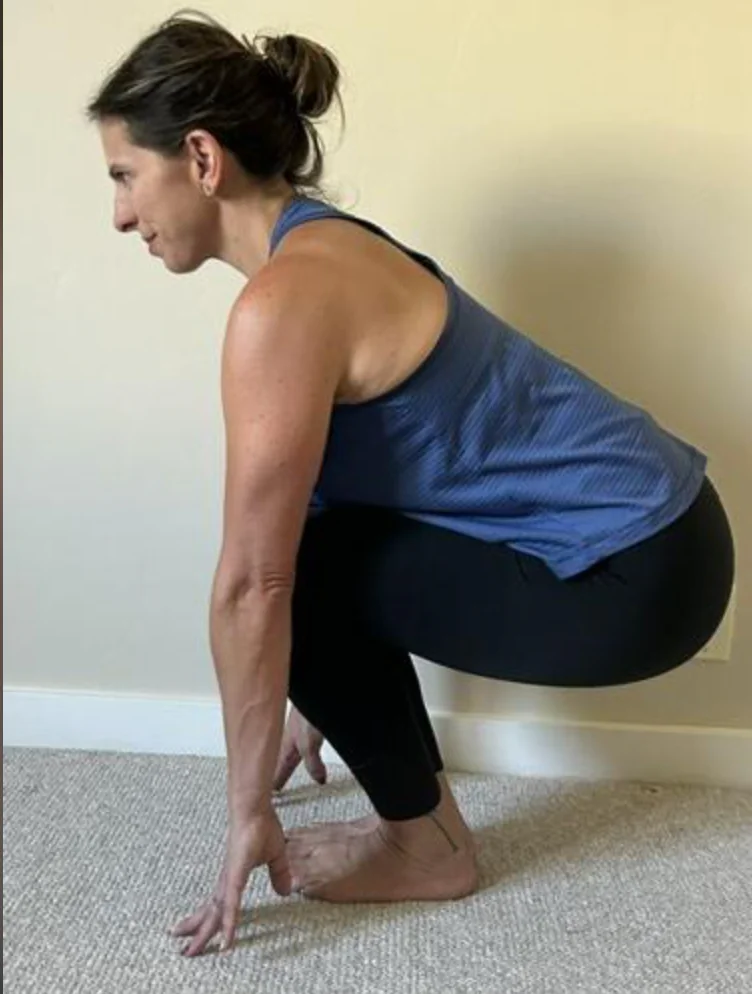
The squat is not just a gym exercise. It is one of the simplest ways to see how the body moves as a whole.
I often get the same question when I meet a new client:
“Why are you watching me squat when I’m here for back pain?”
Watch a toddler pick something up off the floor. Most children drop easily into a deep, balanced squat — heels down, trunk upright, no coaching required. Over the years, tightness, weakness, old injuries, and limited mobility change that pattern. The body finds a workaround. Those workarounds can show up later as pain somewhere else, often in the back.
That does not mean back pain, or any other pain, has to be accepted as a normal part of aging. For the record: I am over 50, I have had both knees replaced, and I can still pass the squat test. The goal is not perfection. It is useful information.
Here is the simple test I use:
Stand with your feet together. Hold your arms out at shoulder height. Keep your heels on the floor and squat as deeply as you comfortably can.
In an ideal squat, I look for:
- Heels remaining on the floor
- Hips dropping below the knees
- Steady balance and control
- Hands reaching toward the floor
- An upright trunk
The point is not to pass or fail. The movement is a snapshot of how the body coordinates mobility, stability, and control. If one area is stiff or weak, another area often takes over. That compensation can travel. Limited ankle motion, for example, can change how the hips and spine move and contribute to back symptoms.
A squat also helps a physical therapist:
Look for a root cause that may sit far from the painful area
Choose treatment that matches the individual pattern
Set a baseline and track change over time
So when I ask a person with back pain to squat, I am not changing the subject. I am looking at the whole chain.
Doing more squats is not always the answer
Many people assume the fix is simply to squat more. If the pattern is already off, extra repetitions can reinforce the same compensations. The areas doing extra work eventually protest. That is when “just keep squatting” starts to hurt.
In the Selective Functional Movement Assessment, or SFMA, a limited squat is not treated as a single problem. It is taken apart, step by step.
First comes a reset. If the squat looks dysfunctional, the exam follows a systematic “breakout” to narrow the source. Is the limit in a joint, in the soft tissue, or in both? Is it coming from the ankles, hips, knees, or spine? Hands-on techniques can restore motion where it is missing and give the system a cleaner starting point.
Then comes reinforcement. Homework starts on day one. The best home exercises do more than one job at a time, so progress does not stall between visits.
Finally comes retrain. This is the “software” side of movement. After an injury, the nervous system often settles into a familiar but inefficient strategy. A graded sequence of assisted and resisted drills can teach a better pattern more quickly than grinding through the old one.
In plain terms: restore what is stuck, protect the new motion, then teach the body how to use it.
Your squat is a brief report on coordination. It can hint at mobility, stability, balance, and the places you have learned to cheat. It will not diagnose every problem by itself, and it should never be forced through sharp pain. Done thoughtfully, though, it tells a clinician where to look next.
That is why the request can sound odd at first. You came in talking about your back. I asked you to bend your knees. The two are often connected.
If getting up from a chair, climbing stairs, or picking something up off the floor has become harder than it used to be, the squat is worth a closer look — not as a contest, but as a window. Movement patterns can change. Pain does not have to be the price of getting older.
READ MORE
5b Gazette, Kim Mazik, MSPT EmPower Concierge Physical Therapy


